
Roots blower deployed for conveying carbon dioxide (CO₂) fall into a distinct category: special-gas Roots blowers. Unlike standard air-moving units, CO2 Roots Blower must contend with CO₂’s unique physical and chemical properties—higher density than air, solubility in water (forming carbonic acid), and the potential presence of moisture or mildly corrosive impurities in applications such as carbon capture, flue gas decarbonization, and chemical synthesis. Consequently, their design and selection diverge significantly from conventional air blowers.
Core Design and Selection Criteria of CO2 Roots Blower
When engineering a system for CO₂ transport, the design strategy must prioritize leakage prevention, corrosion resistance, condensation avoidance, and careful accounting for the gas’s distinct thermodynamic behavior.
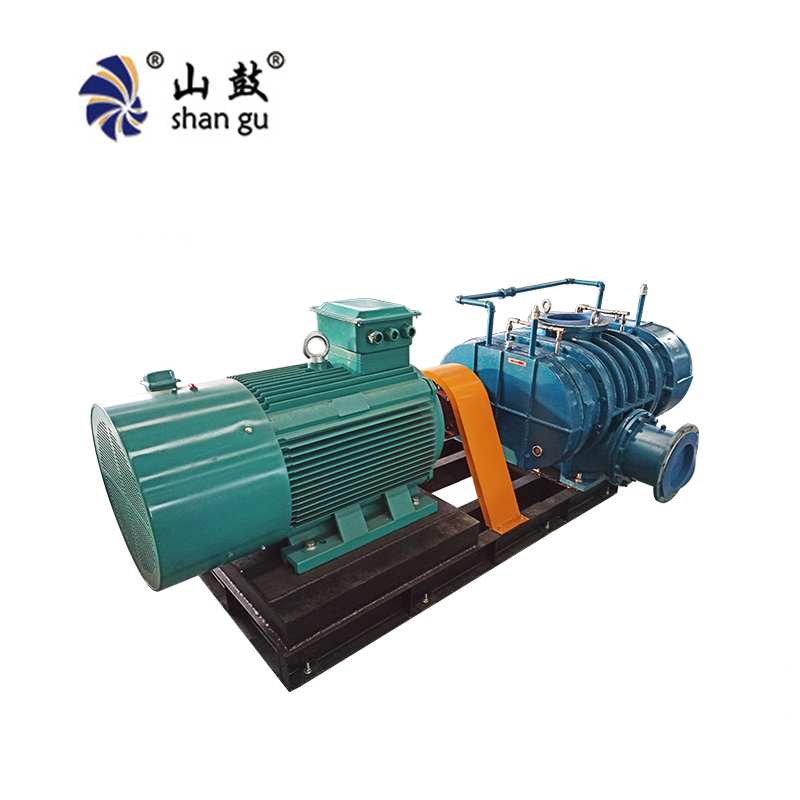
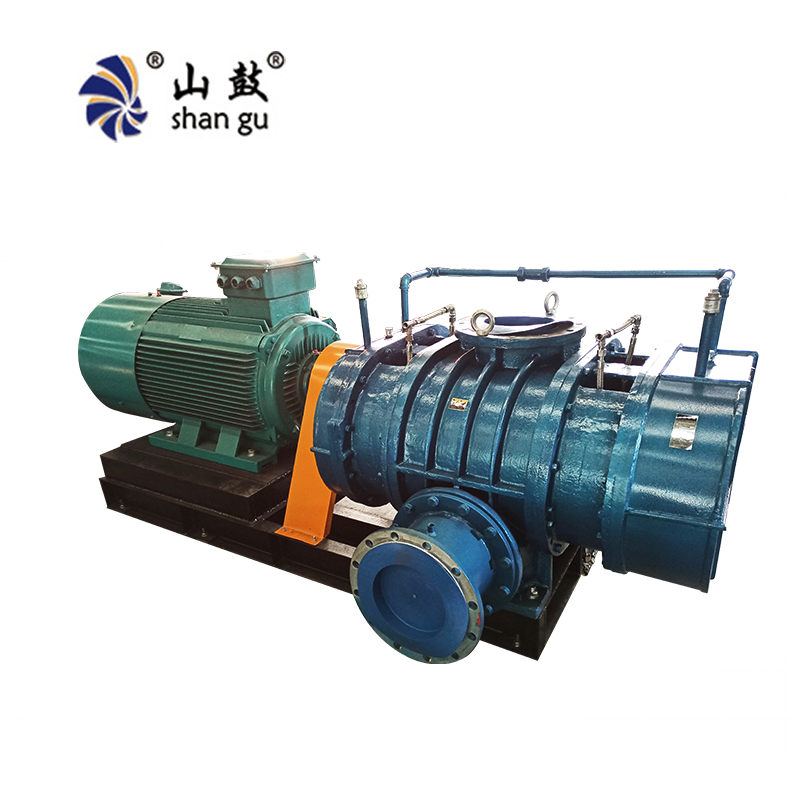
1. Shaft Sealing and Leakage Prevention (Priority #1)
CO₂ is a small-molecule gas that can easily permeate standard seals. In high-purity or critical processes, containment is non-negotiable.
- Purged/Piston-Ring Seals or Mechanical Seals: Traditional lip seals or simple air seals are inadequate. For demanding applications, we specify double-face mechanical seals with PLAN 54 Sealing System. This ensures zero leakage to the atmosphere and prevents lubricating oil from migrating into the gas stream.
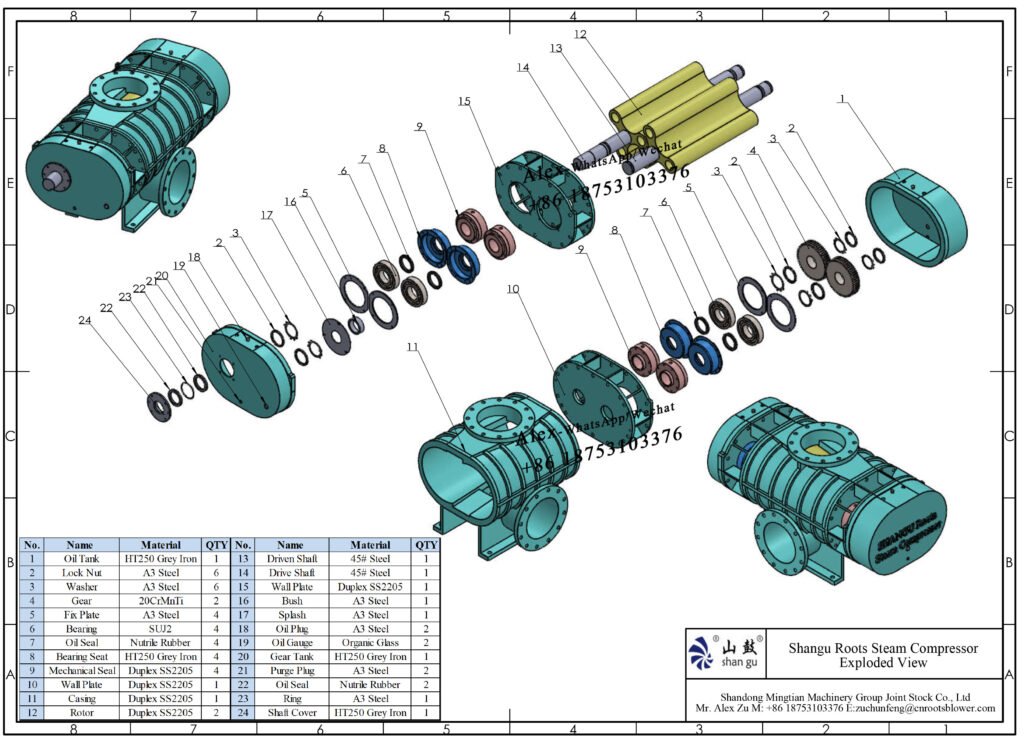
- Bulkhead/Isolation Plate Design: An intermediate wall plate with a vent/relief chamber is essential. This structure physically isolates the lobe-rotating chamber from the bearing housing, ensuring that any minor leakage is directed to a safe vent rather than contaminating the oil sump.
2. Material Selection (Addressing Humidity and Corrosion)
Given the potential presence of moisture and acidic condensate (carbonic acid), the selection of wetted materials is critical for long-term reliability.
- Unified Material Upgrade: To provide robust resistance against both dry CO₂ and wet CO₂ (which forms weak carbonic acid H₂CO₃), all wetted flow components—including the casing, bulkhead plates, and rotors—are specified in 2205 duplex stainless steel.
- Advantages of 2205 Duplex Steel: This grade offers:
- Superior pitting and crevice corrosion resistance compared to standard 304/316L austenitic stainless steels, especially in chloride-containing environments often accompanying wet CO₂ streams.
- Higher mechanical strength (nearly double the yield strength of 316L), which allows for thinner, lighter sections without sacrificing pressure containment capability.
- Excellent resistance to stress corrosion cracking (SCC), a common failure mode in acidic, humid CO₂ services.
- Precision Machining: Despite its higher hardness, 2205 can be precision-machined to maintain the tight rotor-to-housing clearances essential for volumetric efficiency, provided proper tooling and cutting parameters are employed.
3. Thermodynamic Calculation and Performance Check
CO₂’s physical properties demand that standard air-blower calculation methods be adjusted.
- Density and Adiabatic Index Adjustments: CO₂ has a standard density of ≈1.98 kg/Nm³ (vs. air at ≈1.29 kg/Nm³). For the same volumetric flow, shaft power consumption is proportionally higher. As a rule of thumb, the motor power margin should be increased by 15% to 20% beyond the air-equivalent calculation.
- Discharge Temperature Control: The adiabatic index (γ) for CO₂ is ≈1.29, which is lower than air’s 1.4. Under the same pressure ratio, the theoretical discharge temperature rise is slightly lower than that of air. However, final discharge temperature must still be rigorously calculated based on actual inlet conditions (temperature and pressure) to prevent excessive thermal expansion, which could reduce rotor-to-housing clearances and cause a seizure. The higher thermal stability of 2205 material also helps maintain clearance stability under elevated temperatures.
Typical Application Scenarios of CO2 Roots Blower
| Application Field | Process Characteristics | Key Selection Requirements |
|---|---|---|
| Carbon Capture, Utilisation & Storage (CCUS) | Low-pressure boost for adsorption/desorption cycles | High-integrity sealing, corrosion resistance (2205 DSS), high volumetric flow |
| Flue Gas Decarbonisation & Chemical Reactions | Tail-gas recovery, carbonation tower supply | 2205 duplex stainless steel wetted parts, variable frequency drive (VFD) control |
| Food-Grade CO₂ Recovery | Fermentation gas recovery (breweries, bio-fermenters) | 100% oil-free design, 2205 DSS for hygienic and corrosion-resistant service |
| Pneumatic Conveying & Inerting | Using CO₂ as a protective gas to convey combustible dusts | Explosion-proof motor (Ex d), stringent shaft seal, 2205 DSS for durability |
Required Parameters for Proper Equipment Selection
To proceed with a detailed quotation or final engineering design using 2205 duplex stainless steel construction, the following parameters are mandatory. Please prepare these data for your application:
- Inlet Conditions:
- Inlet absolute pressure (kPa)
- Inlet gas temperature (°C)
- Moisture content / Relative humidity (%)
- Flow Rate:
- Standard flow rate (Nm³/min) or actual operating volumetric flow (m³/min)
- Pressure Requirements:
- Required net pressure rise (kPa) or required absolute discharge pressure
- Gas Composition:
- CO₂ purity (%)
- Impurities present (e.g., SOₓ, NOₓ, water vapor, trace oil aerosols, chlorides)
- Electrical & Safety:
- Explosion-proof rating required (e.g., Ex d IIB T4)
- Motor control type (Fixed-speed or Variable Frequency Drive – VFD)
Summary
Selecting a Roots blower for CO₂ service is not a simple “air-equivalent” task. It demands a holistic approach that integrates advanced shaft sealing, robust material selection—here specified as 2205 duplex stainless steel for its superior corrosion resistance and mechanical strength—and corrected thermodynamic calculations. By strictly adhering to the guidelines above and providing complete operational data, engineers can ensure a reliable, efficient, and safe installation that meets the rigorous demands of modern carbon-management and chemical processes, even under aggressive, moist, or mildly acidic conditions.