
Improving Dewatering Efficiency in Paper Mills: The Strategic Role of Roots Blowers
In the modern paper industry, vacuum systems account for a staggering 15% to 25% of a mill’s total electricity consumption. Despite this, many mills still rely on outdated Liquid Ring Vacuum Pumps (LRVPs) that waste water, energy, and maintenance hours. Upgrading to high-efficiency, dry-running Roots blower for paper mill dewatering is no longer just an equipment swap — it is a strategic pathway to slashing operational costs, stabilizing the paper machine, and meeting sustainability targets. This article examines how Roots-type positive displacement blowers are transforming dewatering performance across the wet end of paper machines.
The Physics of Dewatering: Why Vacuum Stability Matters
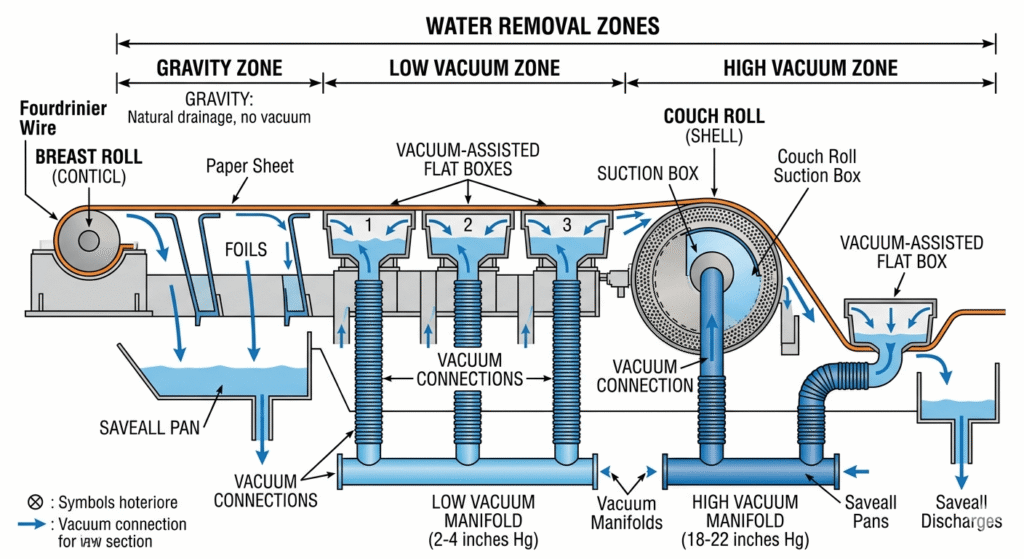
1. Water Removal Zones in the Fourdrinier Section
On the Fourdrinier wire, water is removed in sequential zones using foil blades, flat boxes (low to high vacuum), and the couch roll. Each zone demands a specific vacuum level to gradually pull water from the stock without disrupting fiber formation. A vacuum-assisted drainage solution that delivers non-pulsating, stable vacuum is essential here. Roots blowers, being positive displacement machines, produce a constant flow across a wide range of pressures, creating the ideal vacuum profile for consistent water removal.
2. Impact of Consistent Vacuum on Paper Sheet Uniformity and Quality
Any fluctuation in vacuum directly translates into basis weight variation, uneven moisture profiles, and weakened sheet strength. Liquid ring pumps are prone to pressure pulsations, especially when seal water conditions change. In contrast, a Roots blower vs liquid ring pump in paper mills comparison reveals that Roots blowers inherently provide a smooth, pulse-free airflow. This stability improves fiber distribution and retention, giving mill managers tighter control over sheet quality and reducing broke losses.
Roots Blower vs. Liquid Ring Vacuum Pump (LRVP) for Paper Mill
| Feature | Liquid Ring Vacuum Pump | Roots Blower System |
|---|---|---|
| Energy Efficiency | Low (40–50% at typical operating vacuum) | High (70%+ with VFD integration, 20–40% energy saved) |
| Water Consumption | Continuous seal water required, thousands of liters per day | Zero process water demand |
| Heat Recovery | Difficult — exhaust air mixed with contaminated seal water | Simple — dry, hot exhaust air readily recoverable |
| Maintenance | Frequent (scale build-up, seal replacement, corrosion) | Minimal (dry, non-contacting lobes; only oil and filter changes) |
| Footprint | Large, heavy, needs heavy foundations | Compact, often mezzanine mountable |
1. Energy Efficiency Comparison
LRVPs churn a water ring that causes significant hydraulic friction, limiting isentropic efficiency to around 40–50% in the typical vacuum range for paper mills. Roots blowers, with their tri-lobe rotors and precise clearances, can achieve over 70% efficiency when combined with a Variable Frequency Drive (VFD) that matches speed to demand. Field retrofits consistently show energy savings of 20% to 40%, directly cutting the high cost of vacuum in energy-efficient paper mill vacuum systems.
2. Eliminating Seal Water Consumption
A single medium-sized liquid ring pump may consume 30,000 to 60,000 liters of fresh water per day just for seal water. This generates a huge wastewater burden. Roots blowers operate completely dry — no sealing water, no effluent treatment, and no associated pumping costs. For mills facing strict environmental regulations or high water procurement costs, this is a game-changing advantage.
3. Thermal Energy Recovery
Because Roots blowers compress air without the addition of any liquid, their discharge is a clean, hot (typically 50–120°C) air stream. Mills can easily route this exhaust through a heat exchanger to preheat process water, dry paper machine clothing, or provide space heating. This converts a waste stream into recoverable energy, further improving the mill’s carbon footprint.
Optimizing Key Dewatering Zones with Roots Technology
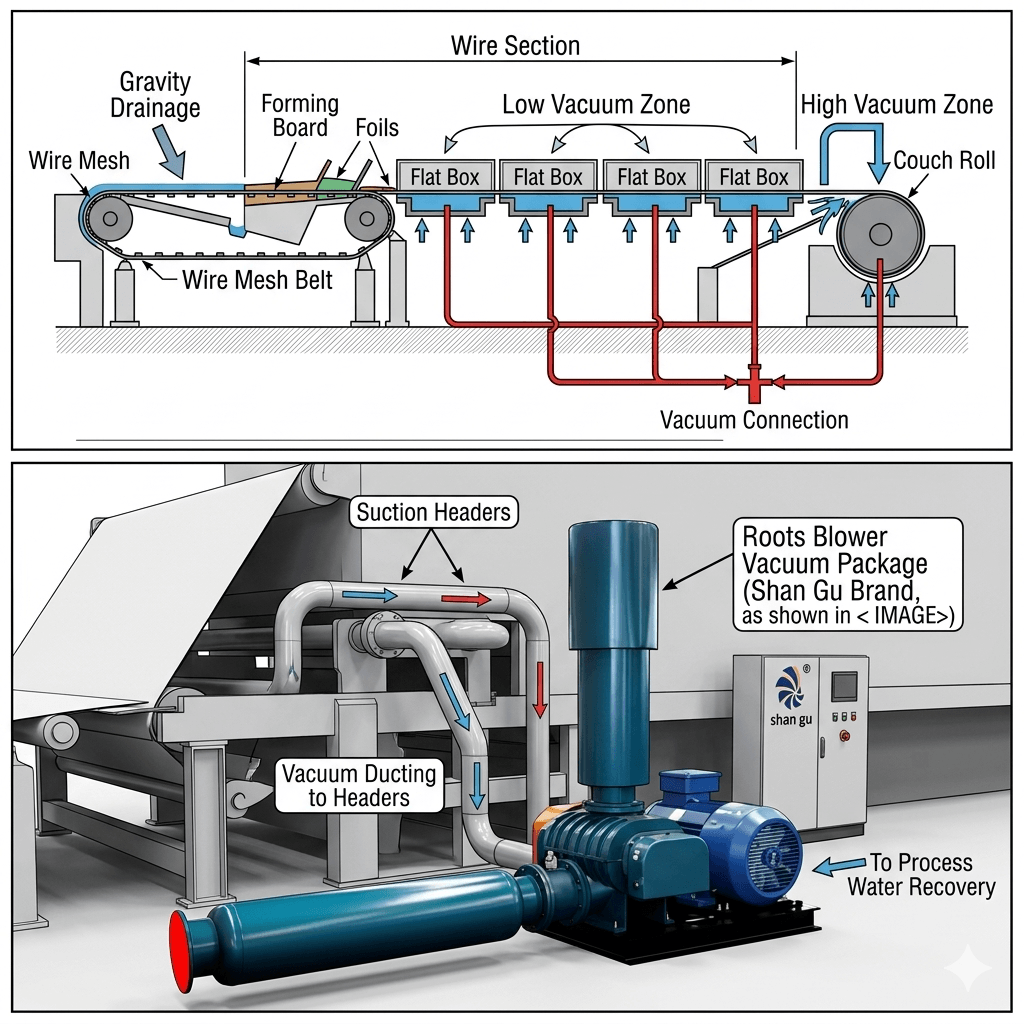
1. The Wire Section (Flat Boxes & Couch Rolls)
The wire section demands high volumes of air at low to medium vacuum levels — the exact sweet spot for Roots blowers. Unlike high-speed turbo blowers that excel at deep vacuum, Roots machines are exceptionally efficient at generating the large airflows needed to remove massive amounts of water during sheet formation. Integrating a Roots blower package with VFD control allows the mill to ramp the vacuum exactly according to the grade being produced, avoiding the wasteful throttling common with LRVPs.
2. The Press Section (Uhle Boxes)
Felt suction boxes in the press section need stable vacuum to continuously dewater the press felts. A saturated felt loses absorbency and lowers nip dryness, which directly increases the steam demand in the dryer section. Roots blowers provide the steady, uninterrupted vacuum that keeps felt moisture content consistently low, extending felt life and maximizing the amount of water removed mechanically — the cheapest form of drying.
Technical Advantages for Industrial Lead Generation
1. Variable Frequency Drive (VFD) Integration
Modern Roots blowers are frequently paired with VFDs, allowing the mill to adjust rotational speed on the fly. When a lighter grade or lower machine speed is required, the VFD reduces motor speed, slashing power consumption proportionally. This flexibility transforms the vacuum system from a fixed-load monster into an intelligent, demand-responsive utility that aligns perfectly with production scheduling.
2. Durability and Maintenance in Harsh Environments
Paper machine rooms are hot, humid, and dusty — a punishing environment for rotating equipment. Roots blowers built for the paper industry, incorporate special corrosion-resistant coatings, robust labyrinth seals, and heavy-duty bearings designed to withstand moisture and airborne fibers. With no internal contact between lobes, there is minimal wear, and regular maintenance is limited to oil and filter changes. For mills seeking a tailored vacuum audit or technical specifications, resources at rootsblowertech.com provide detailed application guidance and case histories drawn from installations in paper mills worldwide.
Economic Impact and ROI Analysis
1. Calculating the Payback Period for a Vacuum System Retrofit
A typical retrofit involves replacing an LRVP with a Roots blower package of equal or slightly lower installed power. The savings stack up quickly:
- Electricity: 20–40% reduction in power draw, often returning over $30,000 per year per 100 kW displaced.
- Water: Complete elimination of seal water and its treatment costs.
- Maintenance: Avoidance of acid descaling, mechanical seal replacement, and pump overhauls.
Most paper mills achieve a payback period of 12 to 24 months, making the vacuum system one of the fastest-returning energy conservation projects in the mill.
2. Case Study: Significant Operational Cost Reduction in a Pakistani Paper Mill with Roots Blower
A packaging board mill in Faisalabad, Pakistan, was struggling with excessive water use and rising electricity bills from three 75 kW liquid ring pumps serving the Fourdrinier flat boxes. They replaced these with two 55 kW Roots blowers equipped with VFDs. The results were remarkable:
- 38% reduction in vacuum system energy consumption, saving approximately $42,000 per year.
- Zero seal water usage, cutting annual water intake by 18,000 cubic meters.
- Maintenance hours dropped by 70%, freeing up manpower for other tasks.
The total project investment was recovered in just 16 months, proving that Roots blowers deliver rapid, tangible returns even in challenging production environments.
Conclusion: The Future of Sustainable and Low-Carbon Papermaking
The road to a low-carbon, low-cost paper mill runs straight through the wet end. Upgrading from wasteful liquid ring pumps to Roots blowers for paper dewatering addresses the three biggest operational pressures facing the industry today: energy cost, water scarcity, and maintenance complexity. With proven energy savings of 20–40%, complete elimination of process water, and the ability to recover valuable exhaust heat, Roots technology represents the “low-hanging fruit” for any mill looking to modernize its vacuum system.
Whether you run a high-speed newsprint line or a heavy packaging board machine, a properly sized and controlled Roots blower package can transform your dewatering process from a cost center into a competitive advantage. To explore how a custom-designed energy-efficient paper mill vacuum system could work in your facility, visit rootsblowertech.com and connect with engineers who specialize in paper mill vacuum retrofits.