
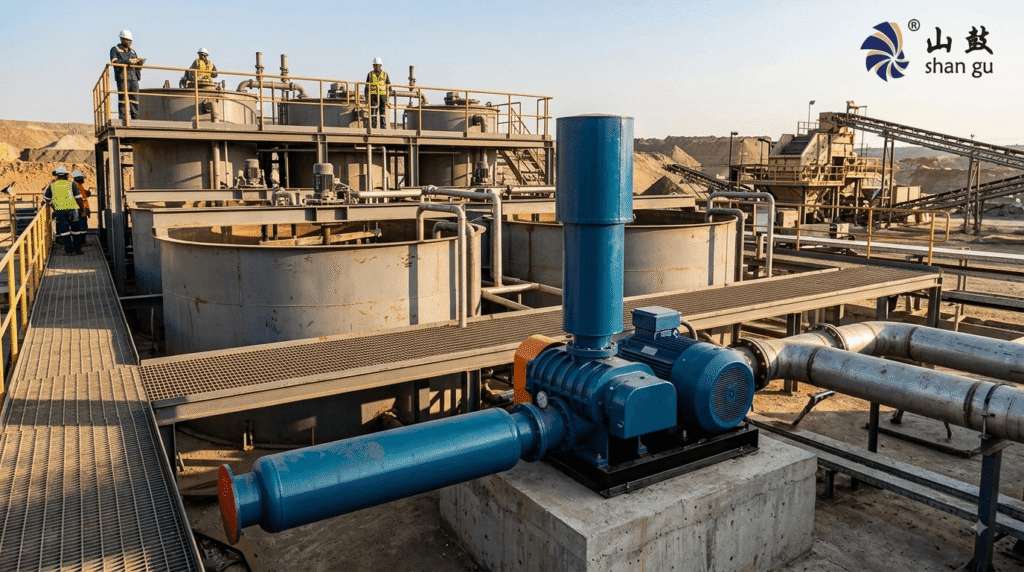
Why Mining Roots Blower is Critical Equipment for Gold Mines and Beneficiation Plants
In modern gold mining operations, reliable aeration is not a luxury—it is a necessity. From cyanide leaching in CIL/CIP circuits to flotation cell aeration and tailings cyanide destruction, the availability of consistent, oil-free compressed air directly impacts gold recovery rates, operational uptime, and environmental compliance. Roots blower has emerged as the preferred aeration solution for mining applications worldwide, offering distinct advantages over traditional compressors and centrifugal fans in the demanding environments of gold and base metal processing plants.
Core Requirements for Blower Equipment in Mining’s Complex Operating Conditions
Mining applications impose some of the harshest operating conditions on industrial equipment. Roots blower deployed in mining environments must withstand:
- 24/7 continuous operation – Gold processing plants run around the clock, with planned maintenance windows often measured in hours rather than days.
- High-dust environments – Ore crushing, grinding, and material handling generate significant airborne particulate matter that can damage sensitive rotating equipment.
- Continuous back-pressure resistance – Submerged aeration in leaching tanks and flotation cells requires the blower to maintain stable discharge pressure against varying slurry depths and densities.
Unique Advantages of Roots Blowers Over Traditional Compressors and Centrifugal Fans
Positive Displacement (Fixed Volume) Delivery – Unlike centrifugal fans, whose airflow drops as back-pressure increases, Roots blowers are positive-displacement machines. Each revolution delivers a fixed volume of air regardless of discharge pressure fluctuations caused by changing slurry depth or density. This characteristic is critical in CIL/CIP leaching tanks where consistent oxygen delivery directly impacts gold dissolution kinetics.
Oil-Free Air Delivery – Roots blowers utilize timing gears and non-contacting rotors, eliminating the need for internal lubrication. The output air is free of oil contamination, which is essential for:
- Preventing fouling of activated carbon in CIL/CIP circuits
- Avoiding contamination of flotation reagents and concentrate
- Protecting downstream processes from hydrocarbon interference
Cost-Effective Low-Pressure, High-Volume Performance – In the common mining operating range of 30–80 kPa (4.3–11.6 psi), Roots blowers deliver superior energy efficiency compared to reciprocating compressors. With efficiency rates of 75–85%, Roots blowers can consume up to 30% less energy than alternative compression technologies. For a 1,000-ton-per-day gold processing plant, this translates to annual energy savings exceeding $50,000.
4 Core Application Scenarios for Mining Roots Blower
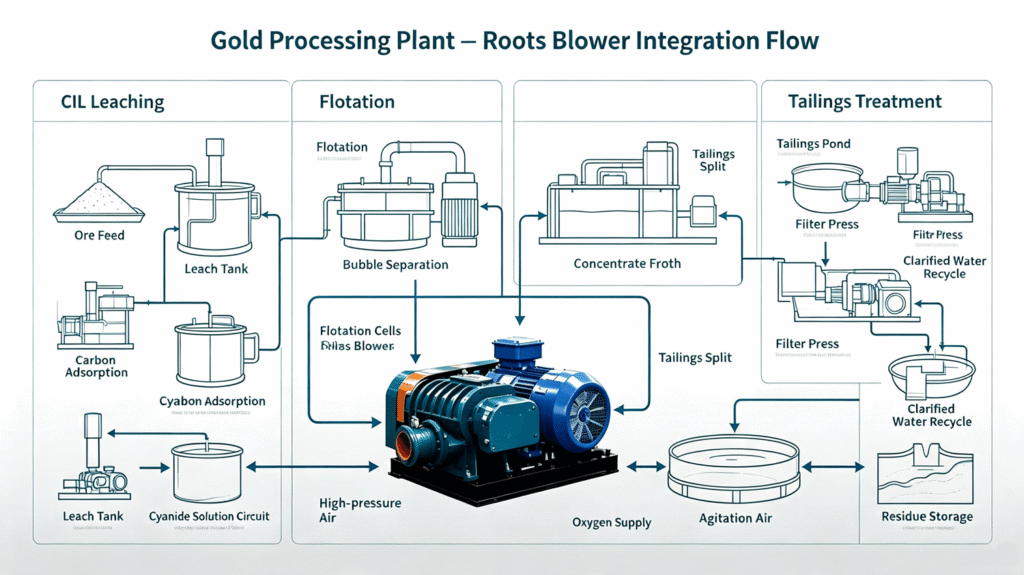
1. CIL/CIP Tank Bottom Aeration for Gold Leaching
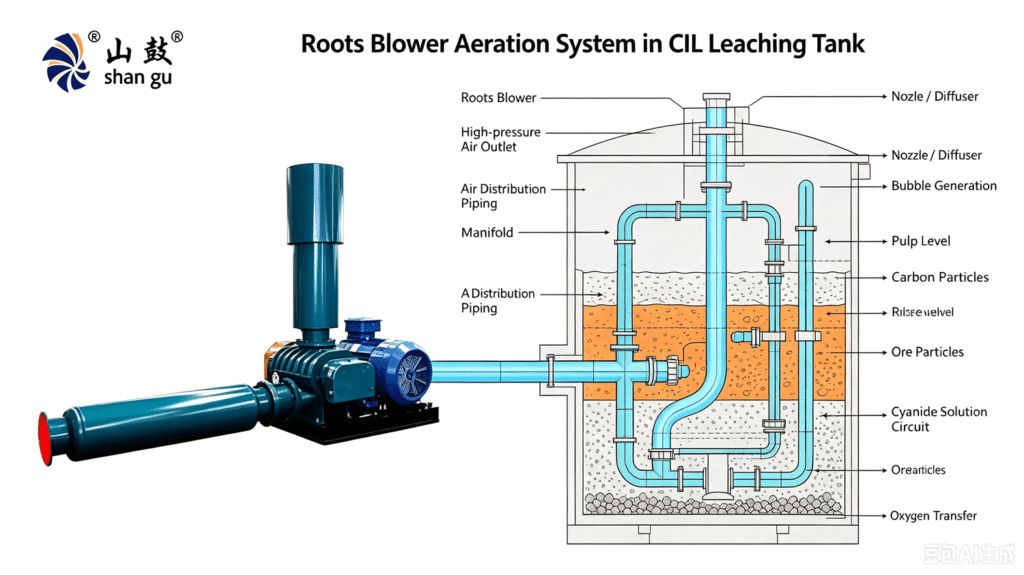
Principle & Function – In Carbon-in-Leach (CIL) and Carbon-in-Pulp (CIP) processes, oxygen is injected into cyanide leaching tanks to accelerate the gold dissolution reaction. A Roots blower introduces compressed air through a distribution system at the tank bottom, providing uniform dissolved oxygen throughout the slurry. Optimized air-agitated tanks can increase gold leaching rates by approximately 0.8% through significantly improved dissolved oxygen levels in the slurry.
Selection Considerations – CIL/CIP aeration demands:
- Continuous long-duration operation – Leaching circuits operate 24 hours a day, 7 days a week. Blowers must be specified for continuous duty with adequate cooling and lubrication systems.
- Bubble uniformity – Fine, evenly distributed bubbles maximize oxygen mass transfer to the slurry. The blower’s discharge pulsation characteristics directly influence bubble size distribution.
- Check valve configuration – Anti-backflow check valves are essential to prevent slurry from siphoning back into the blower during shutdowns, which could cause catastrophic rotor damage.
[IMAGE PLACEMENT – Figure 3: Technical diagram showing Roots blower aeration system in a CIL leaching tank, with air distribution piping and bubble generation detail]
2. Flotation Cell Aeration in Mineral Processing Plants
Principle & Function – Flotation is a core technology for separating valuable minerals (including gold, copper, lead, and zinc) from gangue. Roots blowers supply air to flotation cells, creating bubbles that attach to hydrophobic mineral particles and lift them to the surface for collection. In column flotation cells, low-pressure, high-volume airflow ensures fine gold particles (≤100 μm) are efficiently captured.
Selection Considerations – Flotation aeration requires:
- Low pulsation (three-lobe rotors) – Three-lobe Roots blowers produce smoother airflow with reduced pressure pulsation compared to two-lobe designs. This stability improves bubble size consistency and reduces reagent consumption.
- Stable airflow – Flotation performance depends on consistent aeration. Fluctuating airflow causes uneven bubble generation and recovery losses of 20–30% in sulfide ore flotation.
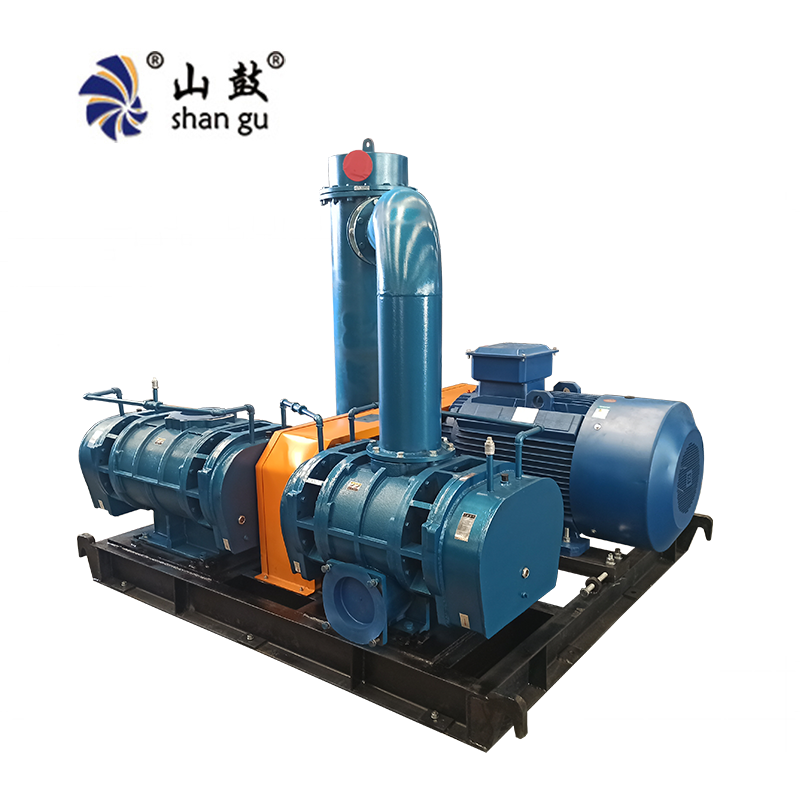
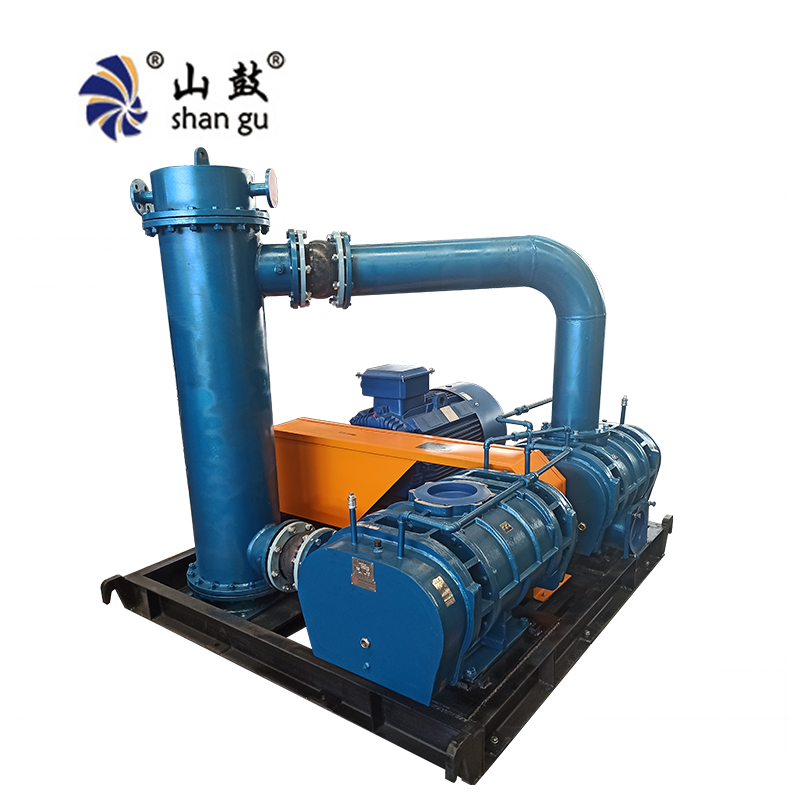
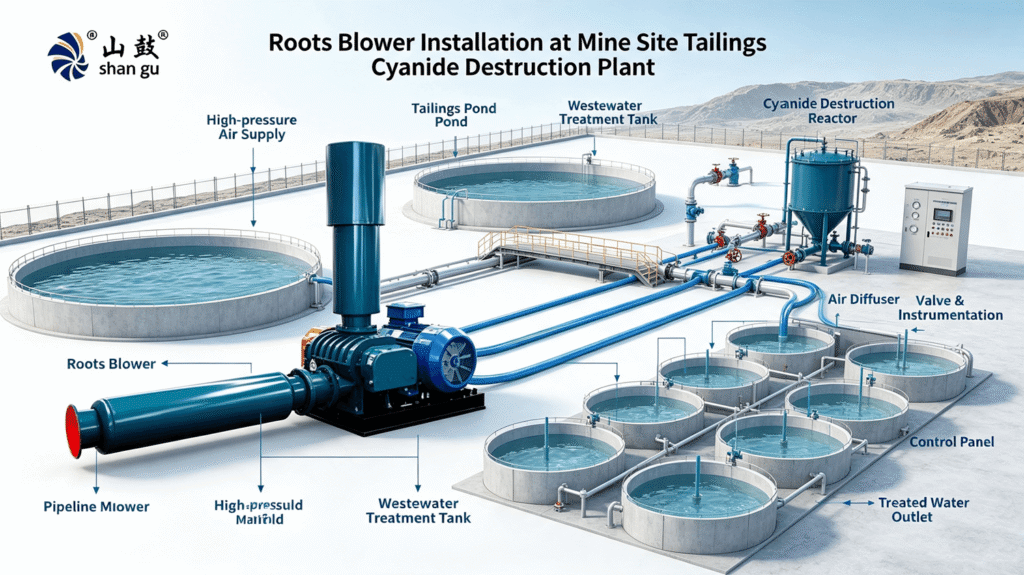
3. Tailings Cyanide Destruction (INCO Process) and Mine Site Wastewater Treatment
Principle & Function – The SO₂/Air (INCO) process is the most common method for destroying cyanide in gold mining effluents globally. Roots blowers provide the essential oxygen supply for the oxidation reaction that converts toxic cyanide into less harmful compounds. Many mines also operate large wastewater treatment facilities that require Roots blowers for biological aeration in activated sludge processes.
Selection Considerations – Cyanide destruction and wastewater applications demand:
- Corrosion-resistant coatings/materials – The acidic and chemically aggressive nature of cyanide destruction circuits requires blowers with specialized coatings or corrosion-resistant alloys.
- High-humidity tolerance – Blowers operating in wet environments or handling humid intake air require appropriate materials and drainage provisions.
4. Pneumatic Conveying of Lime, Limestone, and Activated Carbon
Principle & Function – Roots blowers serve as the air source for low-pressure pneumatic conveying systems that transport dry bulk materials such as lime, limestone, activated carbon, and other powdered reagents. These systems use positive-pressure dilute-phase conveying to move materials from storage silos to process points.
Selection Considerations – Pneumatic conveying requires:
- Pressure stability – Conveying system performance depends on consistent air pressure to maintain material suspension and prevent pipeline blockages.
- Inlet filtration protection – Intake air must be adequately filtered to prevent dust ingress that could damage rotors and bearings.
[IMAGE PLACEMENT – Figure 6: Photo of pneumatic conveying system with Roots blower air supply, showing material transport piping]
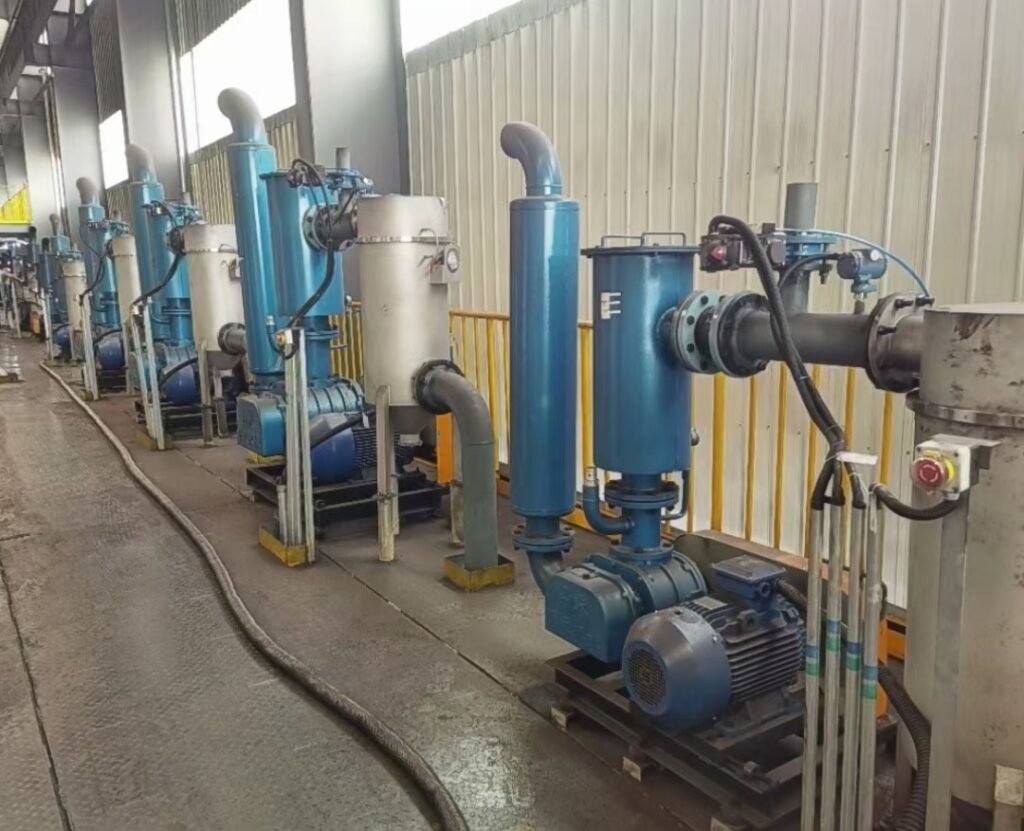
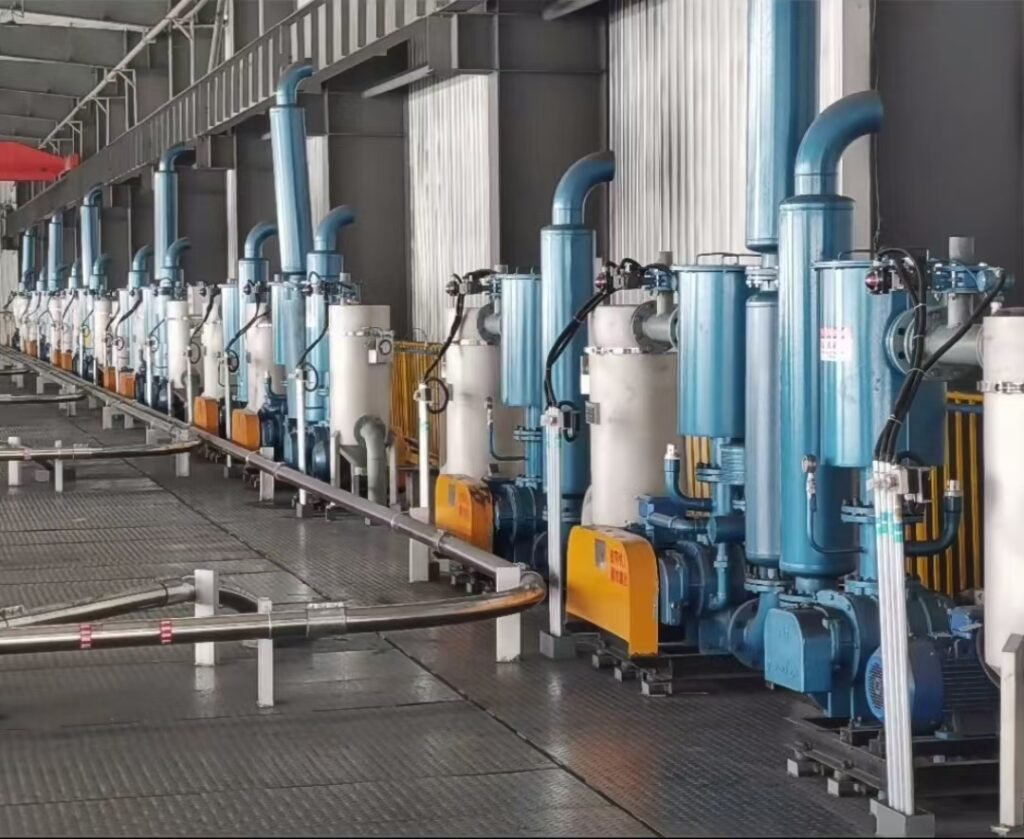
Engineered for Mining Conditions: Customized Design and Protection Measures
Air Filtration and Cooling for High-Dust and High-Temperature Environments
Mine sites present extreme environmental challenges that demand specialized engineering:
Heavy-Duty Two-Stage Intake Filtration – Standard intake filters are inadequate for mining’s dusty conditions. Mining-duty Roots blowers require heavy-duty two-stage filtration systems with:
- Primary filters (50–100 μm) for coarse dust removal
- Secondary fine filters for particulate capture down to sub-micron levels
- Convenient filter access to reduce maintenance downtime and pressure losses
Cooling Systems for Tropical and High-Temperature Mining Regions – For operations in Africa, South America, and other tropical mining regions, blowers must be specified with:
- Adequate cooling capacity for ambient temperatures exceeding 40°C
- Proper ventilation of blower rooms to prevent heat buildup from operating units
- Consideration of temperature derating – for every 10°C increase in intake temperature, air density decreases by approximately 3.4%
Backflow Prevention and Slurry Intrusion Protection
When a Roots blower stops, the pressure differential between the submerged aeration system and the atmosphere can cause slurry to flow backward through the piping. Protection requires:
- High-quality check valves – Installed at the blower discharge to prevent reverse flow
- Relief valves – Configured to protect the blower from over-pressurization during startup or system blockages
- Proper piping design – Including drain points and slope to prevent liquid accumulation
Seal and Bearing Optimization for Extended Maintenance Intervals
Remote mine sites demand equipment that can run reliably between scheduled maintenance visits:
Mechanical Seals and Oil Seals – Mining-duty blowers utilize advanced sealing solutions:
- Fluorine rubber oil seals provide excellent wear resistance and high-temperature tolerance
- Labyrinth seals offer non-contact, wear-resistant operation for high-temperature dust environments such as ash conveying
- Mechanical seal systems prevent dust ingress and lubricant leakage
Mining-Grade Heavy-Duty Bearings – Premium bearing manufacturers such as SKF and NSK provide:
- Self-aligning roller bearings designed to withstand radial and axial loads
- Extended service life in high-vibration, high-contamination environments
Precision Selection Guide for Mining Purchasers
Critical Selection Parameter Calculations
Required Airflow (Q) – Airflow requirements are determined by:
- Leaching tank volume and configuration
- Slurry density and solids content
- Required specific aeration rate (typically 10–30 m³/min for CIL/CIP applications)
- Number of tanks or flotation cells served
Required Pressure (P) – Discharge pressure must overcome:
- Hydrostatic pressure from slurry depth (slurry specific gravity × liquid height)
- Piping and distribution system friction losses
- Diffuser or sparger pressure drop
Pressure calculation:
P = (Slurry Specific Gravity × Liquid Height) + Pipe Losses + Diffuser Loss
Altitude Correction – High-altitude mines require special attention. As elevation increases, atmospheric pressure decreases, reducing air density and mass flow delivery. At 5,000 feet (1,524 m) elevation, inlet pressure drops by approximately 17% compared to sea level.
Altitude correction factors:
| Altitude (m) | Correction Factor |
|---|---|
| ≤ 1,000 | 1.00 |
| 2,000 | 0.83 |
| 3,000 | 0.72 |
The required volumetric flow must be increased by the correction factor to maintain the same mass flow (and therefore the same oxygen delivery) at altitude. For every 1,000 m increase in altitude, airflow and pressure output attenuate by approximately 10%.
Altitude correction formula:
Q_corrected = Q_standard × (P_local / P_standard)
Selection Reference Table (Example)
| Leaching Tank Depth (m) | Slurry SG | Required Pressure (kPa) | Recommended Blower Model | Power (kW) |
|---|---|---|---|---|
| 6 | 1.4 | 35–45 | 3-Lobe, 15 m³/min | 22–30 |
| 8 | 1.5 | 45–58 | 3-Lobe, 20–25 m³/min | 37–45 |
| 10 | 1.6 | 58–78 | 3-Lobe, 30 m³/min | 55–75 |
Note: Values are indicative. Final selection must consider pipe losses, altitude, and specific process requirements.
Daily Maintenance and Spare Parts Management Strategies for Mining Roots Blower
Essential Spare Parts Kit for Remote and African Mining Sites
For mines in remote locations where replacement parts may take days or weeks to arrive, maintaining a comprehensive spare parts inventory is critical. Recommended spares include:
- Air filters – Primary and secondary filter elements (multiple sets)
- Lubricating oil – Appropriate grade and quantity for complete oil changes
- Seals and O-rings – Mechanical seals, oil seals, and gaskets
- V-belts – Full set of drive belts
- Bearings – Premium-grade replacement bearings (SKF/NSK or equivalent)
- Check valve components – Valve discs, springs, and seals
Industry practice suggests maintaining spare parts inventory at 3–5% of equipment value.
Preventive Maintenance Schedule
A structured preventive maintenance program extends equipment life and prevents unplanned downtime:
Daily/Weekly Checks:
- Visual inspection for unusual noise, vibration, or temperature
- Check oil level and condition
- Verify intake filter condition (clean or replace as needed)
- Record operating parameters (pressure, temperature, current)
Monthly Maintenance:
- Grease gear-end bearings (every 20 days to 1 month)
- Inspect and clean air filters
- Check belt tension and condition
Quarterly Maintenance:
- Replace lubricating oil
- Inspect seals and gaskets for leakage
- Check and record vibration levels
- Verify safety and check valve operation
Annual Overhaul:
- Comprehensive inspection of all components
- Replacement of bearings and related wear parts
- Rotor clearance measurement and adjustment if needed
- Full system performance testing
Conclusion-Mining Roots Blower
High-quality mining Roots blower is core assets that directly impact gold recovery rates, flotation performance, environmental compliance, and plant uptime. From providing essential oxygen for CIL/CIP gold leaching to generating bubbles for flotation separation, from enabling cyanide destruction to powering pneumatic conveying systems, Roots blowers deliver the reliable, oil-free, low-pressure aeration that modern mining operations depend on.
In the demanding conditions of gold and base metal processing—with 24/7 operation, high dust loads, and remote locations—proper selection, engineered protection features, and disciplined maintenance are essential for maximizing equipment life and minimizing operational risk.
Contact our engineering team for a free selection report tailored to your specific process conditions, altitude, and capacity requirements.