
Introduction-Roots Blower Drive System
The drive system is the critical link transmitting power from the motor to the impellers of a Roots blower. Selecting the optimal configuration—belt drive or direct coupling—directly impacts operational efficiency, maintenance costs, and long-term reliability. This technical comparison will guide maintenance managers, plant engineers, and procurement specialists through the key factors to consider for applications in wastewater treatment, pneumatic conveying, and chemical processing.
Understanding Belt Drive Roots Blowers
How it Works:
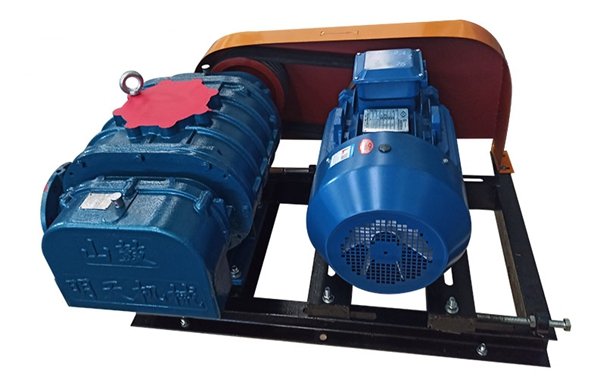
A belt drive system uses a set of V-belts and precisely machined pulleys (sheaves) to transfer rotational energy from the motor shaft to the blower shaft. The pulley ratio determines the final blower speed.
Advantages:
- Speed Flexibility: The most significant advantage is the ability to alter the blower’s RPM and airflow output by simply changing the pulley ratio, without modifying the motor.
- Shock Absorption: Belts act as a damping element, providing a “soft start” and absorbing minor torque fluctuations and vibrations, which protects both the motor and blower.
- Compact Footprint: The motor can be mounted in various orientations (e.g., above or beside the blower), allowing for a more compact installation in space-constrained environments.
Disadvantages:
- Maintenance Intensity: Belts require regular inspection, tensioning, and eventual replacement. Worn or improperly tensioned belts lead to slippage and efficiency loss.
- Efficiency Loss: Typical efficiency losses due to belt friction, flexing, and potential slippage range from 3% to 5%, translating to higher ongoing energy costs.
- Bearing Stress: The constant tension from the belts imposes an axial side load on the blower and motor bearings, which can reduce their service life.
Understanding Direct Coupled Roots Blowers
How it Works:
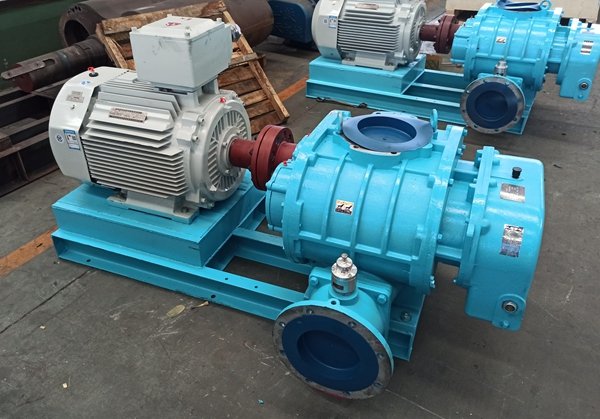
In a direct coupled system, the motor shaft is connected directly to the blower shaft via a flexible coupling (e.g., gear, grid, or elastomeric type). This creates a permanent, 1:1 mechanical link.
Advantages:
- Maximum Efficiency: Power transmission is near 100%, with zero slip losses. This results in lower electrical consumption and operational costs over the system’s lifetime.
- Lower Routine Maintenance: Eliminates belts, tensioners, and sheaves, removing associated maintenance tasks. Primary maintenance involves periodic coupling inspection.
- Enhanced Reliability: Proper alignment minimizes unnecessary axial and radial forces on bearings, promoting longer bearing and seal life.
Disadvantages:
- Fixed Speed: The blower speed is locked to the motor’s synchronous speed. Variable airflow requires the addition of a Variable Frequency Drive (VFD).
- Precision Installation: Requires precise initial laser alignment and periodic realignment. Misalignment is a primary cause of premature coupling and bearing failure.
- Rigid Footprint: The motor and blower must be mounted in-line on a common, rigid base, which may require more linear floor space.
Key Comparison Factors
1. Energy Efficiency and Operational Costs
The choice heavily influences total cost of ownership. While belt drives often have a lower initial purchase cost, their inherent 3-5% efficiency loss leads to higher perpetual energy expenses. Direct couplings offer superior efficiency, maximizing energy savings that typically yield a strong return on investment, especially for continuously operated blowers. The economic crossover point depends on local electricity costs and annual operating hours.
2. Maintenance and Downtime
Maintenance philosophy is a deciding factor. Belt drives demand proactive, hands-on maintenance: scheduled tension checks, belt replacement, and sheave wear monitoring. Direct couplings shift the maintenance focus to precision. After initial laser alignment, they require only periodic alignment verification and coupling inspection, often leading to longer intervals between planned downtime events.
3. Installation Space and Footprint
Layout constraints are practical considerations. Belt drives offer versatile “stacked” or offset mounting, which can conserve floor space. Direct coupled units have a linear, in-line footprint. While potentially longer, this layout is often simpler for piping connections and allows for easier straight-line shaft alignment during installation and service.
Which Roots Blower Drive System Should You Choose?
- Choose a Belt Drive System if: Your application requires specific airflow that doesn’t match standard motor speeds, and you value the flexibility of mechanical speed adjustment. It’s also a strong candidate for installations with severe space constraints or where initial capital cost is the primary driver.
- Choose a Direct Coupled System if: Your priority is minimizing lifetime operating costs through maximum energy efficiency. This is the preferred choice for base-load, continuous-duty applications, especially when paired with a VFD for speed control. It is ideal for teams seeking to reduce routine maintenance tasks and unscheduled downtime.
Conclusion
The decision between a belt drive and a direct coupling for your Roots blower is a balance between upfront cost, operational expense, and maintenance strategy. A belt drive offers flexibility and lower initial cost, while a direct coupling delivers superior efficiency and reduced long-term maintenance. Evaluating the total cost of ownership for your specific duty cycle is essential. For optimal results, consult with a qualified application engineer to match the drive system to your precise operational requirements.
Technical Comparison Table of Roots Blower Drive System
| Feature | Belt Drive | Direct Coupling |
|---|---|---|
| Efficiency | Lower (Typically 95-97%) | Higher (Near 100%) |
| Speed Control | Changeable via Pulley Ratio | Requires VFD |
| Maintenance | High (Frequent tensioning & replacement) | Low (Periodic alignment checks) |
| Bearing Life | Can be shorter (Side-loading stress) | Generally longer (Balanced torque) |
| Initial Cost | Generally Lower | Generally Higher |
| Footprint | Compact, flexible layout | Linear, in-line layout |