
In the fast-paced world of industrial packaging, efficiency and reliability are paramount. While many are familiar with Roots blowers for their role in conveying air under pressure, their application as vacuum pumps is revolutionizing modern industrial packaging lines. Specifically, in high-speed environments requiring high flow rates at low to medium vacuum levels—such as vacuum packaging, bag opening, and material handling—Roots technology offers unparalleled advantages.
This article explores the mechanics of how Roots blowers operate in vacuum mode, their unique benefits for the packaging industry, and why they are becoming the go-to solution for facilities aiming to optimize throughput in 2026 and beyond.
The Mechanics: How Roots Blowers Functions as a Vacuum Pump for industrial packaging lines
To understand why Roots blowers excel in industrial packaging, it is essential to understand the fundamental physics of how they operate when configured for suction rather than pressure.
1. From Pressure to Suction: The Principle of Displacement
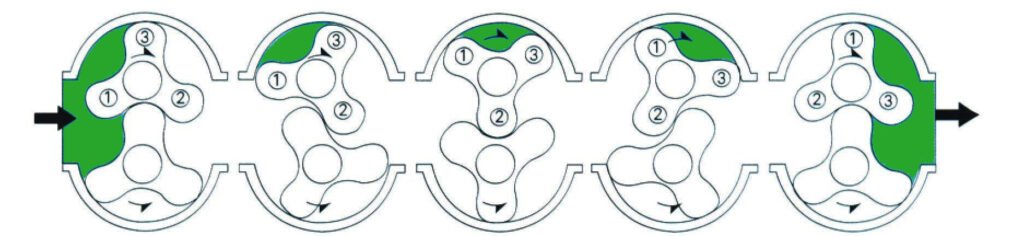
Roots blowers are classified as positive displacement vacuum pumps. They operate using two symmetrically shaped rotors (either two-lobe or three-lobe) that rotate in opposite directions within a close-fitting housing. Unlike compressors that trap and squeeze air, a Roots blower moving air from the inlet to the outlet purely through volumetric displacement.
When configured as a vacuum pump, the inlet is connected to the packaging system (e.g., suction cups). As the rotors turn, they create an expanding volume on the inlet side, causing air to be drawn in from the packaging line. This air is then transported around the housing and expelled through the outlet. The key mechanical feature here is that the rotors do not make physical contact with each other or the housing wall.
2. Dry Running Advantage: Why Oil-Free Matters
One of the most critical differentiators of Roots technology is its “dry running” capability. Because the rotors are synchronized by timing gears housed in a separate gearbox, the pumping chamber itself requires no oil for sealing or lubrication.
This oil-free operation is a game-changer for sensitive industries like food and pharmaceuticals. There is zero risk of oil vapor or mist contaminating the product stream, open food containers, or sterile packaging environments. It ensures that the air evacuated from a package is as clean as the air surrounding it, meeting stringent food grade packaging standards.
Key Advantages in Industrial Packaging Applications
The shift toward Roots blowers in packaging is driven by a combination of mechanical simplicity and operational economics. Here are the primary advantages that make them superior for specific tasks.
1. Handling High Flow Rates and Large Volumes
Packaging lines are often bottlenecked by the speed at which air can be moved. Whether you are rapidly evacuating air from a large bag before sealing, or using suction cups to lift a heavy cardboard sheet, you need high-flow vacuum pumping.
Roots blowers are volumetric machines, meaning they move a fixed volume of air per rotation regardless of speed. This allows them to generate massive suction capacity quickly. In applications like automated pouch filling, this speed translates directly to higher cycles per minute and increased overall line output.
2. Energy Efficiency and Operational Longevity
In the vacuum spectrum, different pumps are suited for different pressure ranges. Roots blowers operate most efficiently in the “rough vacuum” range (down to approximately 15-20 inHg). In this range, they often consume less energy than a rotary vane pump trying to do the same job.
Because the internal components do not make contact, there is virtually no wear and tear on the rotors. This design significantly reduces friction losses, contributing to the machine’s volumetric efficiency and ensuring a long operational lifespan with consistent performance.
3. Minimal Maintenance Requirements
Downtime is the enemy of production. For traditional oil-sealed pumps, maintenance schedules are dictated by the need for frequent oil changes, filter replacements, and seal repairs.
Roots blowers invert this model. With their non-contacting design, there are fewer wearing parts. Maintenance is typically limited to periodic checks of the timing gears and bearing lubrication (often grease-packed for life). This results in predictable, minimal downtime and lower long-term service costs for vacuum packaging line maintenance.
Critical Use Cases in the Packaging Hall
The theoretical advantages of Roots blowers become tangible in specific zones of the packaging line.
1. Automated Pouch Filling and Sealing
In vertical or horizontal form-fill-seal machines, suction is required to open the bag film before the product is dropped in. The vacuum system needs to react instantly to provide a strong, sharp burst of suction to separate the film layers. The high flow rate of a Roots blower ensures that the cups grip the bag material firmly and quickly, reducing the “miss” rate where bags fail to open.
2. Case Packing and Palletizing
End-of-line palletizing relies heavily on vacuum handling for heavy-duty packaging. Robotic arms equipped with suction cups need to lift heavy boxes, bags of flour, or plastic-wrapped bundles. A drop in vacuum pressure here could mean dropping a product. Roots blowers provide a stable, high-volume reserve of vacuum that ensures consistent gripping force, even if there are minor leaks in the system due to porous cardboard surfaces.
3. Centralized Vacuum Systems for Multiple Lines
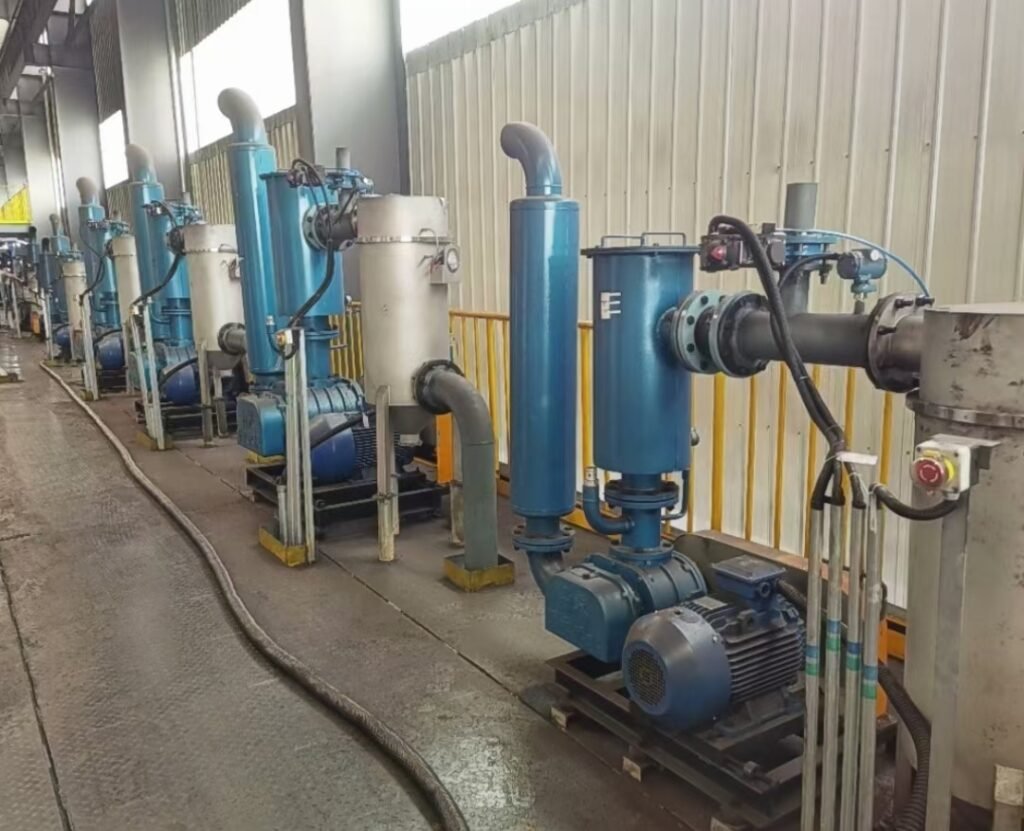
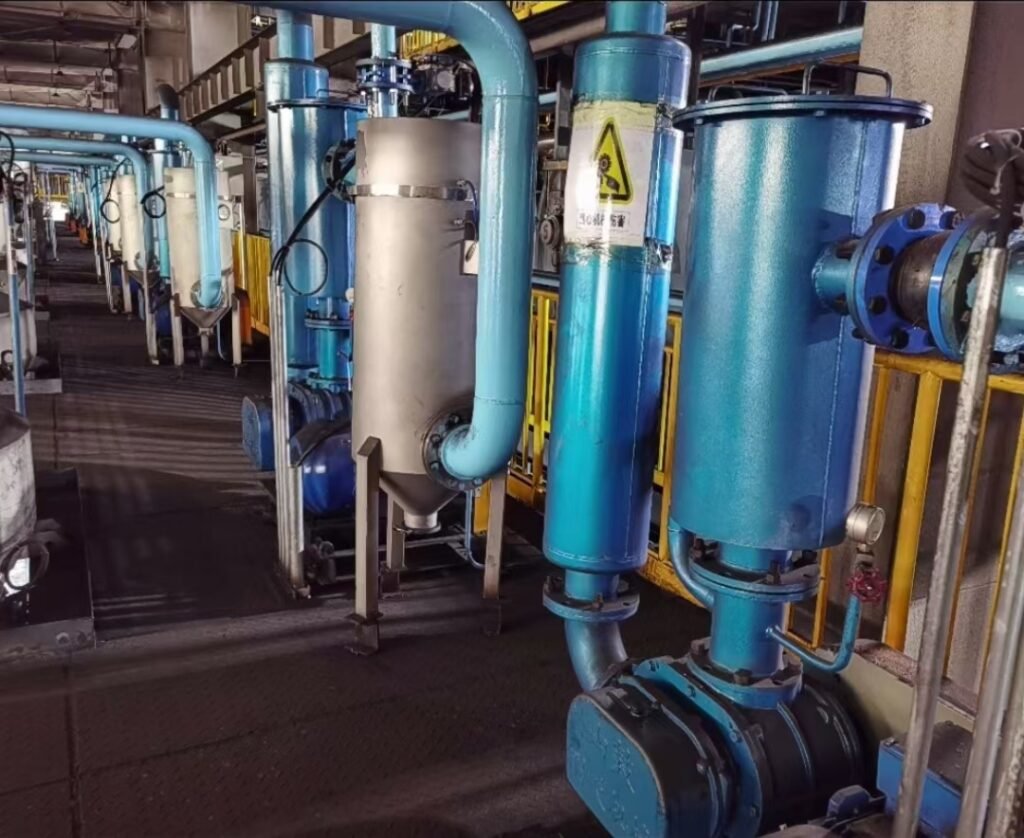
For large manufacturing facilities, installing individual vacuum pumps on every machine is inefficient. Centralized vacuum systems, powered by large Roots blower packages, allow facilities to consolidate their power consumption. A single, high-capacity Roots system can service multiple packaging lines simultaneously, offering better redundancy and easier temperature control compared to dozens of scattered small pumps.
Roots Blower vs. Other Vacuum Technologies
Choosing the right pump depends entirely on the application. To help clarify the landscape, here is a comparison of Roots blowers against the most common alternatives.
| Feature | Roots Blower (Positive Displacement) | Rotary Vane Pump | Liquid Ring Pump |
|---|---|---|---|
| Operating Principle | Dry / Non-contact | Oil-sealed / Contact | Water / Liquid Contact |
| Flow Capacity | Very High | Moderate to High | High |
| Vacuum Level | Low to Medium (Best for rough vacuum) | Medium to Deep (High vacuum) | Low to Medium |
| Contamination Risk | None (Oil-Free) | High (Oil mist/vapor) | Low (but creates wastewater) |
| Maintenance | Low (Bearing/Gear checks) | High (Frequent oil changes) | Medium (Seal/fluid changes) |
| Best For | High-speed bagging, conveying, lifting | Chamber vacuum sealing | Wet, harsh, or corrosive gases |
If your packaging operation requires deep vacuum (close to 29 inHg) for thermoforming, a rotary vane pump is likely necessary. However, for the vast majority of industrial packaging vacuum systems involving movement, lifting, and holding, the Roots blower is often the superior choice.
Factors to Consider for Integration Roots Blowers in Industrial Packaging
Implementing a Roots blower into your packaging line is not simply a “plug-and-play” affair. Proper integration is key to maximizing the benefits.
1. Matching Suction Capacity to Line Speed
Undersizing the pump leads to slow cycle times, while oversizing wastes energy. You must calculate the total volume of air that needs to be moved per cycle and the frequency of the cycles. This “air handling” requirement dictates the specific model of blower required to maintain a steady pressure differential.
2. Noise Mitigation and Heat Dissipation
Roots blowers are high-speed machines, and they generate noise and heat. When integrating them into a workspace, consider acoustic enclosures to protect worker comfort. Additionally, because the vacuum process heats the air as it is compressed, proper ventilation or after-coolers may be necessary to dissipate heat from the mechanical room.
3. Pre-filtration for Dust and Debris Recovery
Packaging environments are rarely perfectly clean. In applications involving powder filling (like flour, sugar, or cement), dust can be pulled into the vacuum line. Because Roots blowers have tight clearances between rotors, introducing abrasive dust can cause damage. A robust pre-filtration system with high-efficiency inlet filters is mandatory to protect the investment and ensure dust and debris recovery does not enter the pump chamber.
Conclusion: Optimizing Your Industrial Packaging Line with Roots Blowers for 2026
As packaging lines push for higher speeds and greater automation, the demands on vacuum technology evolve. The Roots blower, when used as a vacuum pump, provides a compelling solution that aligns perfectly with the industry’s goals: high throughput, low energy consumption, and minimal downtime.
By offering dry running operation, massive flow rates, and mechanical simplicity, Roots technology addresses the specific pain points of modern packaging—from sensitive food handling to heavy-duty palletizing.
For plant managers and engineers looking to upgrade their systems, integrating a Roots-based central vacuum system could be the key to unlocking the next level of productivity in 2026. Whether you are replacing aging rotary vane pumps or designing a new greenfield facility, consider the volumetric efficiency and longevity of Roots blowers to keep your packaging line running smoothly.