
The Role of Roots Blower in Enhancing Wastewater Treatment Aeration Efficiency
Aeration is the most energy-intensive process in a wastewater treatment plant (WWTP), typically accounting for 50% to 70% of the facility’s total power consumption. It is critical for the biological degradation of organic pollutants, where microorganisms require a steady and reliable supply of oxygen. Selecting the right aeration technology is therefore paramount for operational efficiency and cost control. Among the various options, Roots blowers have established themselves as a robust, efficient, and reliable solution, particularly for small to medium-scale activated sludge plants. This guide explores how Roots blowers maximize aeration efficiency, reduce energy costs, and ensure consistent treatment performance.
Understanding the Mechanics: Why Roots Blowers for Aeration?
Positive Displacement Principle
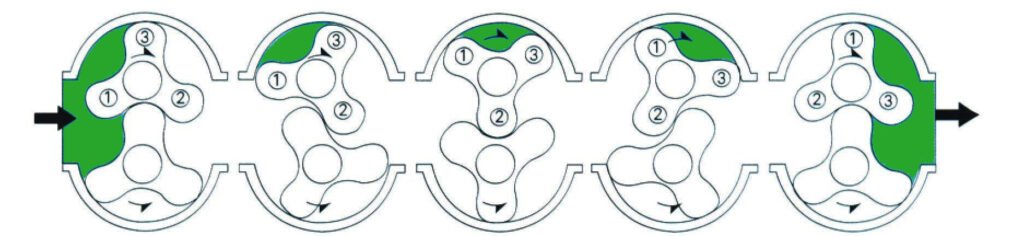
At the heart of a Roots blower is the positive displacement principle. Two counter-rotating, symmetrically shaped rotors (typically two-lobe or three-lobe) trap a fixed volume of air in the pockets between the rotors and the casing wall. This air is carried from the intake side to the discharge side without internal compression. The key outcome is a constant, pulsating airflow that is largely independent of the system’s discharge pressure within its design limits. This makes it inherently suitable for applications requiring a steady air supply against a variable head, such as aeration basins where water level and diffuser fouling can change back pressure.
Consistent Airflow Under Varying Pressure
In a WWTP, the back pressure on the aeration system can fluctuate due to factors like changing water depth, diffuser condition, and valve positioning. Unlike some dynamic compressors whose flow rate can drop significantly with increased pressure, a properly sized positive displacement blower delivers a nearly constant volumetric flow. This consistency is crucial for maintaining stable Dissolved Oxygen (DO) levels, which directly impact microbial activity and treatment efficacy. Engineers value this predictability for process control and system design.
Key Ways Roots Blowers Enhance Aeration Efficiency
Optimized Oxygen Transfer Efficiency (OTE)
The true measure of an aeration system’s effectiveness is its Oxygen Transfer Efficiency (OTE)—the percentage of oxygen delivered that actually dissolves into the water. Roots blowers excel when paired with fine bubble diffusers. The consistent, pulsating airflow from the blower helps maintain an even distribution of bubbles at the basin floor, maximizing the surface area for oxygen transfer. This synergy leads to higher OTE compared to coarse bubble systems, directly translating to lower energy consumption for the same amount of oxygen delivered.
Reliability and Low Maintenance
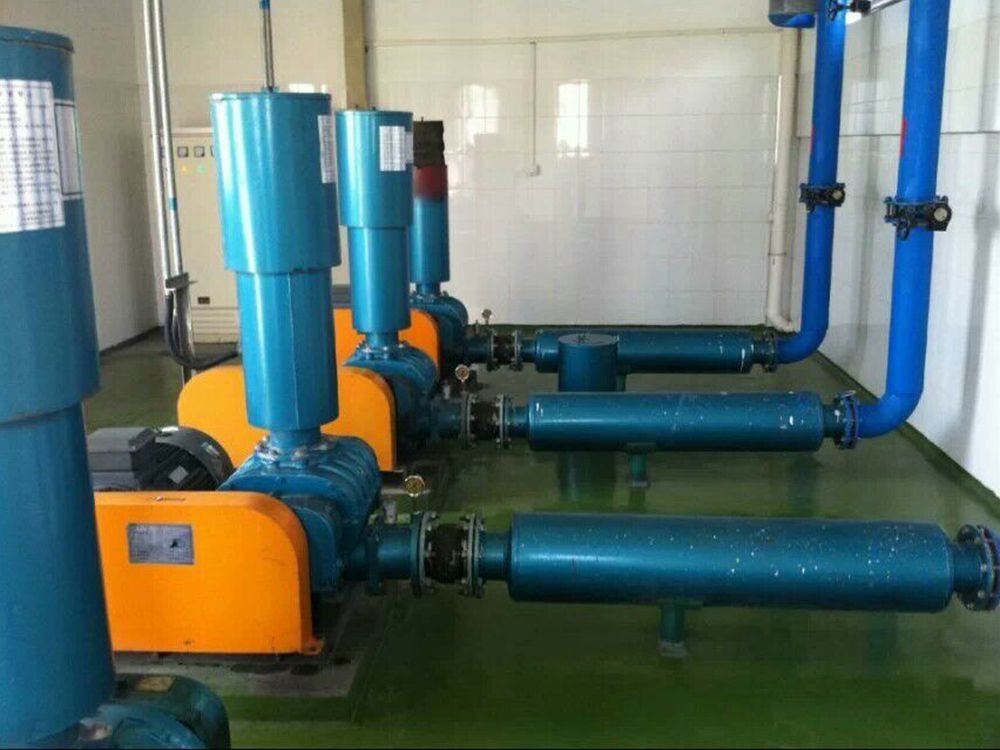
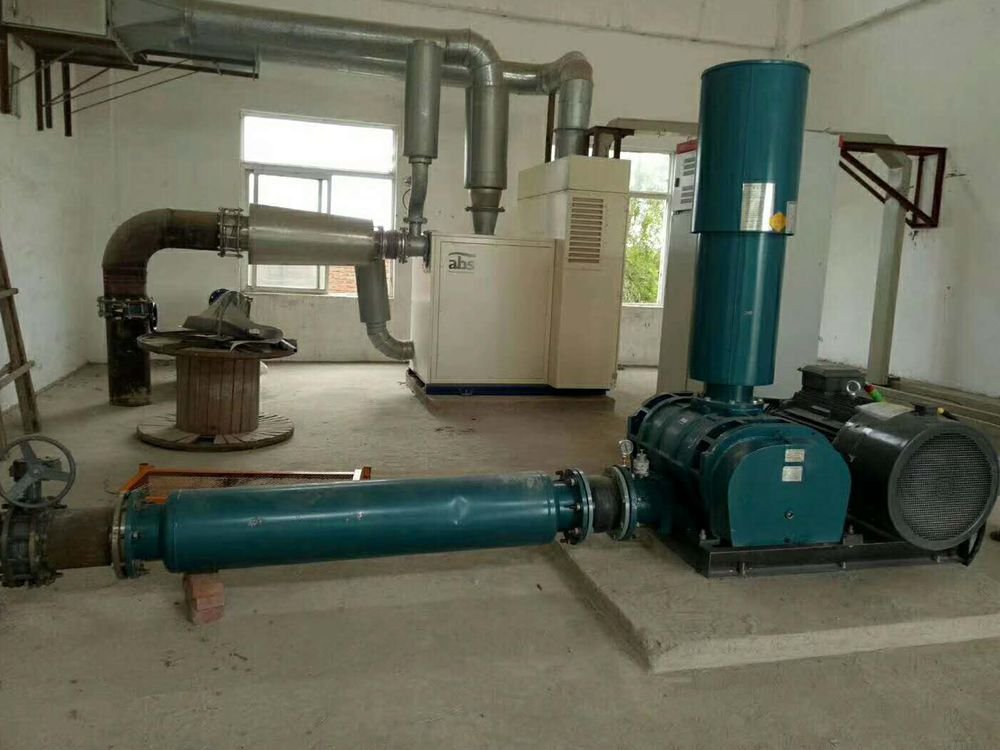
For plant managers, efficiency isn’t just about kilowatts; it’s also about uptime. Roots blowers have a simple, rugged design with few moving parts and no internal metal-to-metal contact. This results in exceptional reliability and lower lifetime maintenance costs compared to more complex high-speed machines. Reduced unplanned downtime means the biological process runs continuously, avoiding efficiency losses and potential compliance issues from process upsets.
Heat Dissipation Management
Air compression generates heat. Roots blowers are inherently adiabatic machines, meaning most compression heat is added to the air stream. While this heated air can slightly improve oxygen transfer in colder climates, it must be managed to protect downstream fine bubble diffusers from accelerated fouling or damage. Modern systems often incorporate aftercoolers or consider this factor in piping design. Proper thermal management is a key design consideration to ensure long-term system efficiency and component life.
Energy Efficiency: Roots Blowers vs. Other Technologies
Comparison with Centrifugal Blowers
The choice between Roots blowers and centrifugal blowers often depends on plant scale and airflow requirements. Centrifugal blowers (single or multi-stage) are generally more efficient at very high flow rates and stable pressure conditions. However, for many municipal and industrial WWTPs with flows up to ~15,000 m³/h and fluctuating demands, Roots blowers hold a strong advantage. Their flat performance curve ensures efficient operation across a wider pressure range without surging risks. Furthermore, their efficiency at partial load conditions is often superior, which is critical as aeration demand varies daily.
The Impact of Variable Frequency Drives (VFD)
Integrating a Variable Frequency Drive (VFD) with a Roots blower is a game-changer for energy consumption in WWTP. Traditional constant-speed blowers rely on throttling valves or bypass loops to regulate airflow, wasting significant energy. A VFD allows the blower speed to be adjusted precisely to match the real-time oxygen demand signaled by DO probes. This “on-demand aeration” can reduce energy use by 20% to 40%, providing a rapid return on investment. Modern Roots blower packages are increasingly offered with integrated, optimized VFD controls.
Critical Factors for Maximizing Performance
Proper Sizing and Selection
The greatest efficiency losses occur from an improperly sized blower. An oversized blower will operate in an inefficient part of its curve or cycle on/off excessively, wasting energy. Undersizing leads to process failure. Selection must be based on a thorough analysis of airflow rate (CFM or m³/h), maximum required back pressure, site conditions, and future load projections. Partnering with an experienced supplier for proper sizing is the first step toward an efficient system.
Monitoring Dissolved Oxygen (DO) Levels
Automation is key. Implementing a closed-loop control system where DO probes continuously monitor the mixed liquor and feed data back to the blower’s VFD creates an efficient feedback loop. This ensures oxygen levels are maintained within the optimal range for BOD/COD removal without over-aerating, saving energy and improving process stability.
Routine Maintenance for Peak Performance
Even robust equipment needs care. For Roots blowers, simple but consistent maintenance preserves efficiency:
- Air Filter Service: Clogged filters increase pressure drop and power consumption.
- Oil Changes (for oil-lubricated models): Clean oil ensures proper bearing and gear lubrication, reducing friction losses.
- Rotor Clearance Checks: Maintaining proper clearances prevents efficiency degradation over time.
A well-maintained blower operates at its design efficiency for its entire service life.
Future Trends: Smart Aeration and High-Efficiency Roots Technology
The future of aeration lies in intelligence and refined hardware. Smart aeration systems now integrate blower control with wider SCADA and PLC networks, using advanced algorithms and predictive analytics to optimize the entire treatment train. On the hardware side, advancements in Roots blower technology continue. The adoption of three-lobe rotors over traditional two-lobe designs reduces air pulsation and noise, leading to smoother operation and potentially longer bearing and rotor life. Further refinements in rotor profiles, manufacturing tolerances, and sealing technologies are pushing the boundaries of efficiency and reliability for positive displacement blowers.
Conclusion
In the demanding environment of wastewater treatment, Roots blowers remain a cornerstone technology for efficient and reliable aeration. Their positive displacement design delivers the constant, controllable airflow essential for effective biological treatment, especially when paired with fine bubble diffusion and modern VFD control. By focusing on proper sizing, integration with DO monitoring, and disciplined maintenance, plant operators and engineers can leverage Roots blowers to significantly reduce the largest single energy cost in their facility. As technology evolves towards smarter, more integrated systems, the fundamental strengths of the Roots blower—simplicity, durability, and predictable performance—ensure it will continue to play a vital role in sustainable wastewater management.
💡 Energy Saving Calculation Example:
Consider a 100 HP Roots blower operating 24/7. Without VFD control, it may run at full power constantly. With VFD integration for on-demand aeration, average speed might drop to 80%.
- Annual Energy without VFD: 100 HP * 0.746 kW/HP * 24 hrs * 365 days = ~653,000 kWh
- Annual Energy with VFD (at ~80% avg. speed): Power consumption scales roughly with the cube of speed. (0.8)³ = 0.512. 653,000 kWh * 0.512 = ~334,000 kWh
- Annual Savings: ~319,000 kWh. At an electricity cost of $0.10/kWh, this equals ~$31,900 in annual cost savings, demonstrating a compelling ROI for the VFD upgrade.