
Introduction: Why Understanding the Roots Blower Working Principle
In modern industrial processes, from wastewater treatment to pneumatic conveying, the demand for reliable, consistent, and efficient air movement is paramount. Among the available technologies, the Roots blower, also known as a rotary lobe blower, has maintained an irreplaceable position for over a century. Its fundamental principle offers unique advantages that centrifugal fans or screw compressors cannot always match. As we navigate 2026, the industrial focus has sharpened on energy efficiency and operational stability. New global standards emphasize not just raw power but the intelligent delivery of constant flow and superior energy efficiency ratios. Understanding the core working principle of the Roots blower is no longer just academic—it’s essential for engineers and plant managers to make informed decisions, optimize systems, and reduce total cost of ownership.
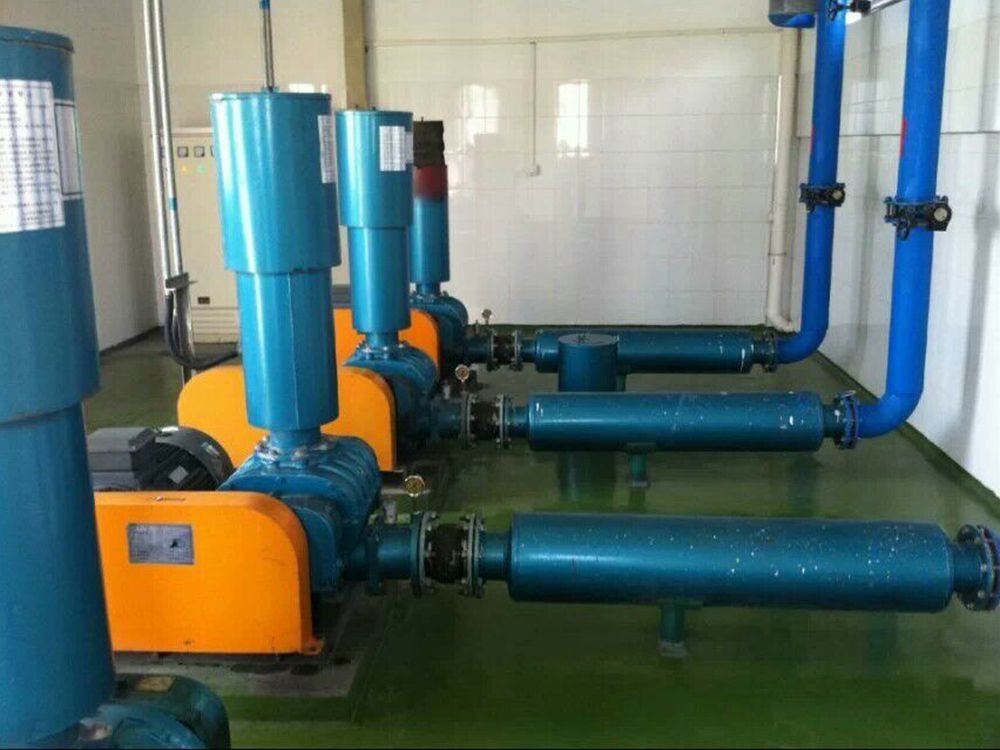
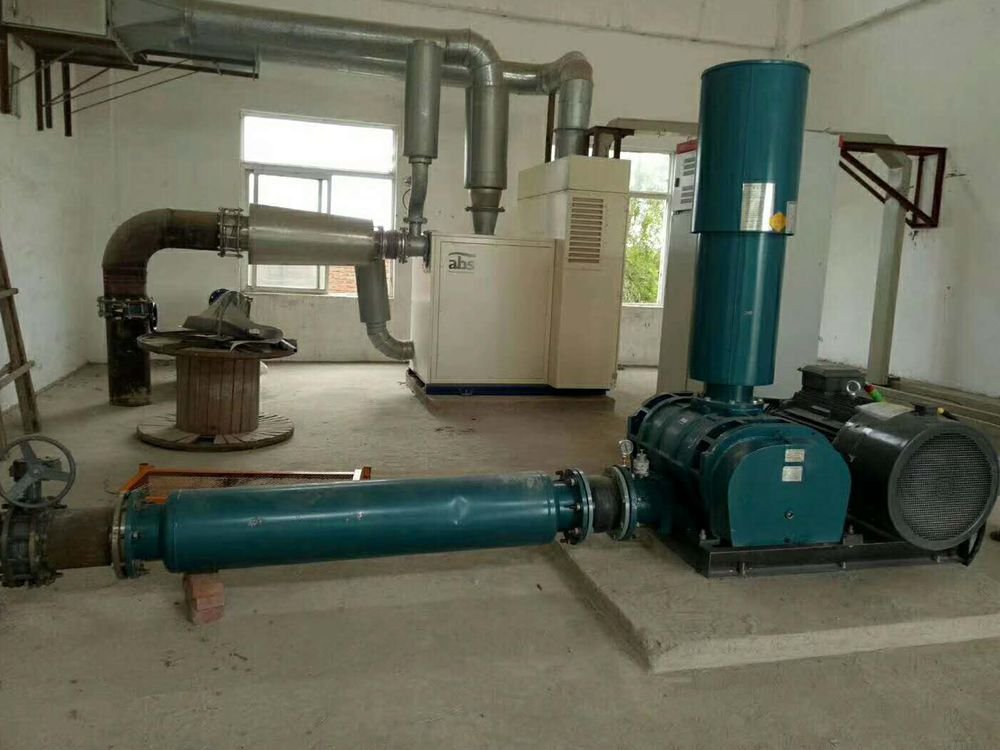
What is a Roots Blower? (The Definition)
A Roots blower is classified as a positive displacement blower. Typically configured with two or three lobed rotors (lobes), it operates by trapping a fixed volume of air or gas and mechanically displacing it from the intake side to the discharge side. The defining characteristic that sets it apart from compressors like screw or piston types is its method of pressure creation: a Roots blower does not compress air internally. Instead, it delivers a constant volume of air against a system’s resistance (back pressure), and the compression event occurs externally at the moment of discharge. This fundamental distinction is the key to its performance profile.
Step-by-Step Breakdown: The Working Cycle
The operation of a Roots blower can be visualized in four distinct, repeating phases. The following diagram illustrates this cycle clearly(Roots Blower Working Principle):
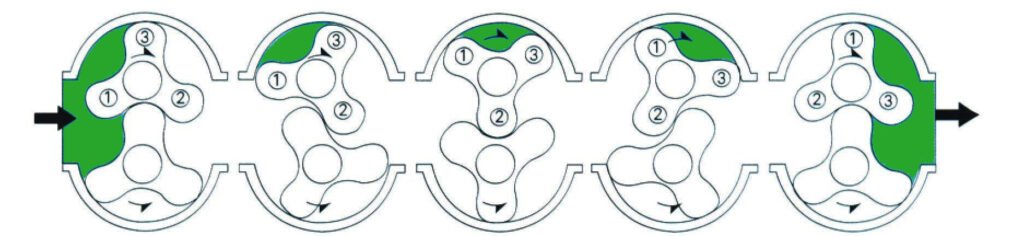
- Intake Stage: As the counter-rotating lobes turn, they separate at the inlet port. This action creates a vacuum, drawing air or gas into the expanding chamber formed between the lobe and the blower casing.
- Transfer Stage: The lobes continue to rotate, sealing the inlet port. The trapped volume of air is now encapsulated in a pocket between the rotor lobes and the housing wall. This pocket is transported, unchanged in volume, around the inner circumference of the casing towards the outlet side.
- Compression Stage (The Critical Phase): This is the core of the Roots principle. As the leading lobe tip begins to uncover the discharge port, the trapped air pocket—still at near-inlet pressure—is exposed to the higher-pressure air already present in the discharge header. This causes a rapid, nearly instantaneous backflow of high-pressure air into the pocket. This external compression is adiabatic and generates significant heat. The pressure equalizes, raising the entire pocket to the system pressure.
- Discharge Stage: With the pocket now pressurized, the continued rotation of the lobes pushes the compressed air out of the discharge port and into the system pipeline. The cycle then repeats seamlessly with the next lobe.
Two-Lobe vs. Three-Lobe: The 2026 Industry Standard
Historically, two-lobe designs were common. However, the evolution towards quieter, more efficient operations has solidified the three-lobe rotor as the 2026 industry standard for most applications. The primary advantage lies in fluid dynamics: a three-lobe design increases the number of discharge pulses per revolution, which significantly reduces the amplitude of each pulse.
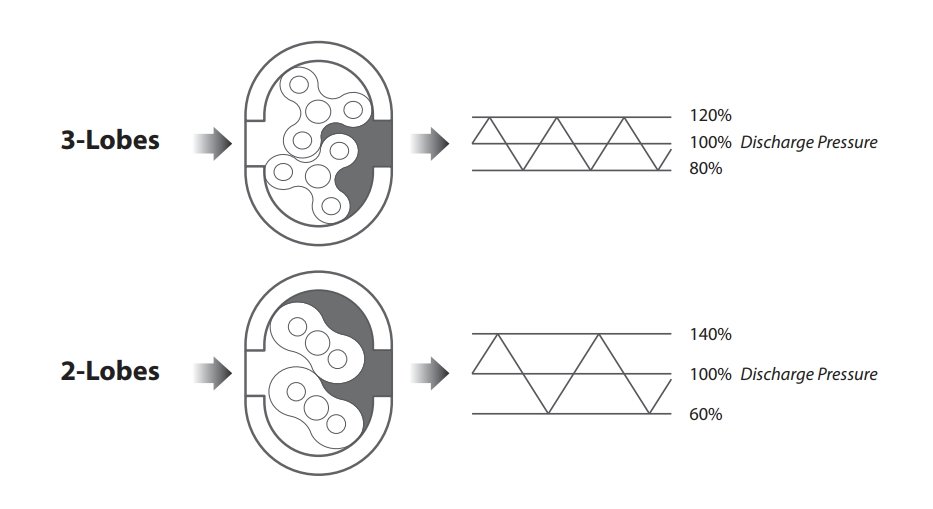
| Feature | Two-Lobe Blower | Three-Lobe Blower |
|---|---|---|
| Pulses per Revolution | 2 | 3 |
| Pressure Pulsation | Higher amplitude | Lower amplitude |
| Noise Level | Higher | Significantly Lower |
| Flow Irregularity | More pronounced | Smoother |
Technical Animation/Visuals (Essential for SEO)
A static diagram can only convey so much. The synchronized, non-contact motion of the rotors is best understood through animation.
Critical Components and Their Roles
The elegant principle relies on precision engineering of its key components:
- Timing Gears: These are the heart of the blower’s reliability. Mounted on the rotor shafts outside the air chamber, these synchronous gears ensure the rotors maintain a precise phase relationship, rotating in opposite directions without ever making contact. This allows for microscopically small clearances, enabling zero friction between the rotors and eliminating the need for internal lubrication, guaranteeing oil-free delivery.
- Rotors (Lobes): Machined to high tolerances from robust materials like cast iron or stainless steel. The precise profile of the lobes and the controlled clearance between them and the casing are critical for efficiency and preventing backflow.
- Bearings & Seals: Bearings support the rotor shafts, handling radial and axial loads. Shaft seals, often labyrinth or mechanical seal types, are crucial for preventing air leakage and keeping contaminants out of the bearing housing, further ensuring the purity of the delivered air.
Performance Characteristics in 2026
The working principle of the Roots Blower directly dictates performance:
- Constant Flow Characteristic: As a positive displacement device, its volumetric flow rate is primarily a function of speed and size, not discharge pressure (within design limits). This makes it ideal for applications requiring a steady air supply despite varying system back pressure.
- Adiabatic Compression & Heat: Since compression happens rapidly at the discharge port, it is primarily adiabatic. The energy used to create pressure is largely converted into heat, leading to a significant temperature rise in the discharged air. Modern (2026) designs integrate efficient cooling systems and sometimes external aftercoolers to manage this thermal load, which is vital for system safety and efficiency.
Common Applications Based on Principle
The principle leads directly to its ideal use cases:
- Wastewater Treatment Aeration: The constant flow is perfect for maintaining stable dissolved oxygen levels in biological treatment basins.
- Pneumatic Conveying: Provides a steady stream of air to move powders and granules without pulsing that could clog lines.
- Industrial Vacuum: Can create high-volume vacuum for central systems or filter cleaning.
- Combustion Air Supply: Delivers predictable air volumes for consistent firing in furnaces or burners.
Conclusion & Maintenance Tip
The Roots blower’s longevity and operational stability are direct results of its simple, robust working principle and precise engineering. The non-contact rotor design minimizes wear, making it a cornerstone of reliable industrial operations. To ensure this longevity, the most critical maintenance focus is on the components that enable the principle: regularly checking and replacing air intake filters to prevent erosion of internal clearances, and monitoring timing gear alignment and lubrication. A well-maintained Roots blower can deliver decades of service.
Ready to specify the right blower for your 2026 project? [Get our detailed technical datasheet for complete performance curves and specifications].
FAQ (Frequently Asked Questions)
Q: Does a Roots blower compress air internally?
A: No, this is the key distinction. A Roots blower is an external compression device. It moves a fixed volume of air to the discharge side, where compression occurs suddenly as the trapped air mixes with the higher-pressure air already in the system.
Q: What is the difference between a Roots blower and a centrifugal fan?
A: A Roots blower is a positive displacement device, delivering a relatively constant volume flow even as system pressure changes. A centrifugal fan is a dynamic device; its flow rate is highly sensitive to system pressure—flow drops significantly as pressure rises. Roots blowers are better for constant-flow/high-pressure-differential applications, while centrifugal fans excel in high-volume, low-pressure, variable-flow scenarios.
Q: Why are timing gears so important?
A: Timing gears are crucial because they synchronize the rotors, allowing them to rotate in very close proximity without touching. This enables the critical internal clearances that make the blower efficient, oil-free, and long-lasting.
Q: How does the three-lobe design reduce noise?
A: The three-lobe design increases the frequency of the discharge pulses while reducing the energy of each individual pulse. This results in a smoother airflow with lower amplitude pressure waves, which translates directly to lower aerodynamic noise compared to a two-lobe design.